LOST IN GRIEF
Helping you find direction through your grief journey


Hi everyone,
Today I am writing my blog in Belfast. I am here with my three close friends for a weekend. We each have had our own experiences of loss and grief and we use our time together to relax and enjoy each others company. These nights away together, give us a break from our normal routines.
This week I will be looking at ‘Support’ or lack of support. Where it comes from. Where you thought it would come from and where you were surprised it came from.
Grief is individual. In a previous blog “Malaga Memories”, I wrote about Instrumental and Intuitive grievers. The type of support you need will depend on the type of griever you are.
We all react differently to loss. Think about a time before your loss. How did you approach a bereaved person? Did you visit their home? Send them a letter or card? Attend the funeral? Avoid them because you didn’t know what to say? We can feel hurt when people we know well avoid us and it often happens to those of us who are bereaved.
We recently had a holiday in Quarteira in the Algarve in Portugal. It is a beautiful place right on the coast. We were having a meal one evening at an outdoor restaurant and two ladies sat at the table next to us.


At the end of our meal, we had a chat. One of the ladies told me that she been married here over twenty years ago. Her husband had died two years previously but she felt a need to return. When she mentioned this to her family, her sister (the lady with her) immediately offered to go with her.
“She’s my support. The rest of the family thought I was mad wanting to do this”.
The lady was an instrumental griever. She recognised the type of support she needed was practical support. Help with travelling and making arrangements. She acknowledged that it had been sad, but she was so happy that she did it.
Not all of us would have found comfort through this. When my dad was alive, he and my mum would come on holiday with Stephen and I to La Carihuela on the Costa del Sol. Since my dad’s death, my mum feels it would be too painful to return as it holds too many memories. Both of these examples are fine. We need to do what helps us most. Some people avoid going to cafes they visited with their loved one, or anywhere that brings back memories. Everyone is different.
Emotional support is needed by the intuitive griever. They want to talk about the person who they’ve lost. They want you to listen while they tell their story. The more often they tell their story, the more they will come to accept the reality of their loss. Often family and friends will change the subject when you talk about your loss. This is because they believe it makes you sad. They might even might even explain it to you
“Mum, don’t talk about dad anymore, you know you’ll end up crying”
When you identify which type of support you need, that’s a good starting point. Think of the network around you. Family, friends, church, groups, counselling and your doctor. Look for information on practical issues such as financial aid. Try and make your support network larger. Loneliness is one of the most common factors in grief. This was magnified during the Covid epidemic. Loved ones were unable to attend funerals or visit each other. Social networks were broken down and many people were alone in their grief. This increased the physical and mental health issues for the bereaved.
SOME THEORY
Tonkins Grief Model
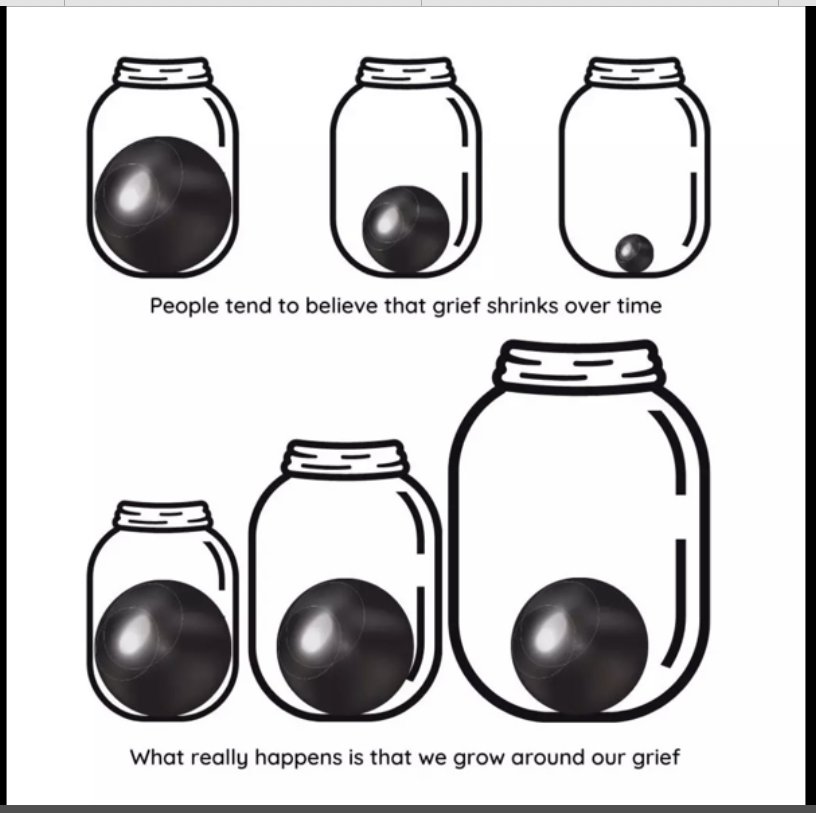
If you look at the top row of jars, it shows that what people tend to believe, is that grief (the ball in the jar), will shrink over time. However, if you look at the bottom row of jars, it shows that grief stays the same over time but we grow around our grief. We grow around our grief by growing our network and doing more activities (no matter how small). Re-read the Dual Process Model in my blog ‘Waves’.
THE LAST WORD
Where you surprised by where your support came from? Did you find that some people who you expected to support you, avoided you? This is common when you are bereaved. Sometimes this is because people don’t know how to approach you and don’t know what to say. As time passes, it becomes more difficult for them to talk to you. Try and let the disappointment go and focus instead on your social support.
I offered bereavement support to a young man and his six year old daughter, after the death of his wife. He visited his wife’s grave every day on his way to work. Sometimes he would stay five minutes, sometimes half an hour. By chance, I met his mother who was very concerned by her son’s behaviour. She said that it wasn’t normal and encouraged me to make him stop. I explained that he was getting comfort from these visits and it was not interfering in his day to day life. I would become concerned if he stayed at the graveside so long that he didn’t go to work. Or if he visited the grave in the afternoon and forgot to pick up his daughter from school. His mother wasn’t convinced but I tried to reassure her that we all grieve differently.
Some people visit the grave often. Some on special occasions. Some do not visit the grave. We are all different. Go with what is meaningful to you and what gives you comfort. For those of you who did not have the ritual of a funeral, where bodies were never found for example, my heart goes out to you. Perhaps setting up a little memory corner in your home or garden might help. It’s whatever gives you the most comfort.
As my weekend with my friends ends, I feel a little sad. It might be months before the four of us meet up again. But we will do it. We are a great support to each other and encourage each other in self-care.
TYPES OF SUPPORT
*Emotional: Someone listening; being alongside you
*Practical: Someone helping with daily tasks, cooking a meal, going to the shops or helping with childcare
*Informational: Providing contact numbers for financial assistance, support groups etc
*Companionship: People who will spend time with you.
I find my support through family and friends. I have recently finished a course of life coaching session with Laura Anderson, based here in Bangor. Laura helped me move forward from a rut I had found myself in. It has been an interesting journey.
Can you identify your social support network? If you don’t have support, do you think you could try to reach out? I know this can be very difficult when you are grieving but you could maybe make a small start.
Remember:
Grief in individual.
There is no timeline on grief.
Until next time,
Lorraine

 Lost in Grief
Leave a comment