LOST IN GRIEF
Helping you find direction through your grief journey

Hi everyone,

Welcome back. Today I am writing my blog from the lovely Ballygally Hotel on the Antrim coast in Northern Ireland. It has uninterrupted views of the Irish Sea. I love watching the movement of the sea and find it calming. Stephen and I are here for a few days, just taking it easy. There are very few certainties in life, but the ebb and flow of the tide is one of them.
The weather is grey outside and there are some small waves. It reminds me of the waves of grief.
Do you find that some days you cope better with your grief than others? You may have found that you have felt slightly better and able to do more, then out of nowhere grief hits you hard.
It can be frightening and you begin to wonder if you are getting worse. Something may have acted as a trigger. Perhaps finding something belonging to the person you have lost; remembering a conversation that you shared or a special date such as birthdays or anniversaries.

I have an image that I believe explains this well. If you can imagine yourself walking waist deep into the ocean and turning your back on the horizon to face the shoreline. You stand there for a while and a wave shocks you by pushing you under the water. You struggle to stand up. Another wave covers you and you struggle again. Going under the water you struggle to reach the surface and steady yourself. This continues until you realise that it has been some time since you have experienced the wave. Times passes. You become more stable. Then a wave covers you again and pushes you under the water. With your back to the horizon, you cannot see the waves coming, so you are unprepared. As time passes, the length of time between each wave may get longer, but they will still come. However, what also happens, is that you learn you will survive the waves. You will begin to recognise the feelings and understand that you will come back to the surface and steady yourself.
Grief comes in waves.
Can you identify with this image? Can you see it in others who are bereaved?
The Dual Process Model
I have found this model helpful while offering bereavement support. Draw the oval diagram below on a piece of paper. On the left hand side, write down how your loss affects you, physically and emotionally. These are normally the things that prevent you moving towards the right hand side of the diagram, restoration. Keep your words simple. On the restoration side, write things such as, going to the shops; meeting a friend for coffee etc.
None of us can grieve 24 hours a day so we oscillate between Loss and Restore. We may only stay on the restoration side for an hour or so, but that doesn’t matter. It gives us a break from being emerged in grief.
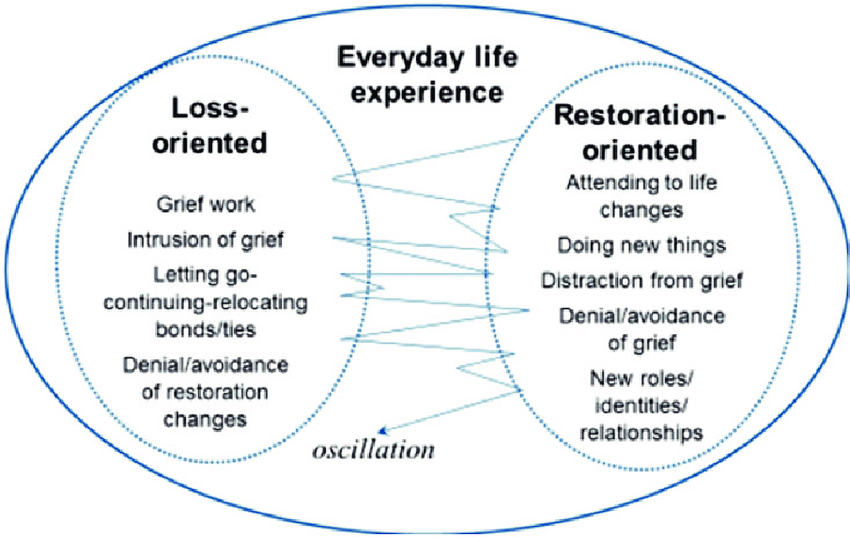
This model is useful in helping identify how we move through our grief. We will not remain static or move from our loss completely but moving between the two sides will help us take a break from our grief. The more we try this, the longer we can stay on the restoration side as we do more. However, we will always return to our loss just like the waves of grief.
(I have adapted this model from Strobe and Schut 1999; The Dual Process Model of Coping with Bereavement)
I met a lady in Westport, Co. Mayo while on holiday. She was travelling with her sister for a few days. She told me about this being the first trip away from home since the death of her son, he was 34. She talked openly about his sudden death and how how her grief had impacted on her daily living. She refused to leave the house and she felt overwhelmed to do even the smallest task. She had been completely stuck on the loss side of the model. Eventually, with support from her friends and family, she was able to go out for a short time to have a coffee (a move to restoration). These moves towards restoration increased over time. She was able to identify that she had met up with friends for an hour, had been shopping, had worked in her garden and had spoken to her manager about returning to work on a part-time basis.
The model can help show that you are engaging in life and working towards restoration. It will not ‘take away’ your grief but help you identify how you are finding direction through your journey.
Is this something that you have tried?, or be willing to try? Sometimes the simple things can be helpful.
The Last Word
So, as I sit here in the Ballygally Hotel, after a lovely breakfast, looking out at the Irish Sea, I am thinking about loss, restoration and the waves of grief. It’s the unexpected hits of grief that can frighten us the most. We can feel that we are moving backwards, getting worse. If you use this diagram you can add to it and make changes as you move through you journey in grief.
“Grief is like the ocean; it comes in waves, ebbing and flowing. Sometimes the water is calm and sometimes it is overwhelming. All we can do is learn how to swim”
Vicki Harrison
So, as I look through the window, the sky and sea are still grey but there is a little brightness from the west. I hope your sea is a little calmer today.
Until next time,
Lorraine
 Lost in Grief
Leave a comment